CareConnect · Alaska Airlines
AI-Enabled Customer Care / Enterprise UX / Human-AI Interaction
What should AI take off someone's plate—and what should it never take out of their hands?
Designing an AI-assisted Customer Care experience that reduced observed task time by 25% while preserving human judgment, review, and accountability.
Role: Senior UX Designer & Researcher
Writing was only one part of the job. Agents still had to understand the customer's situation, check information, navigate requirements, and decide what was appropriate to communicate.
For Alaska Airlines Customer Care, I led research and owned interface design from early exploration through pilot, iteration, rollout, and post-launch evaluation. CareConnect—originally CareBot—supported analysis and drafting; the agent remained responsible for the response.
- Lower observed task time
- 25%
- Without → with CareConnect
- 13:29 → 10:05
- Initial pilot—not comparison sample size
- ~8 agents
Measured in an observed task comparison; not end-to-end case-resolution time.
The 30-second read
- Who was doing the work
- Customer Care agents researching customer situations and composing written responses.
- What I owned
- Senior UX Designer & Researcher. Led research and owned interface design from the initial version through iteration and post-launch evaluation, alongside Customer Care, product, engineering, and Photon AI partners.
- What changed my approach
- Drew the line between where AI could reduce composition effort and where the agent had to stay in control of review, editing, and the final response.
- Verified outcome
- Approximately 25% lower observed task time · 13:29 → 10:05 · 3:24 difference. Measured task segment, not end-to-end case-resolution time; exact comparison sample size and baseline stopping action are not documented.
- Where it landed
- Approximately 8 pilot agents, then the broader CSA letter-writing team and groups including Central Baggage and Advocacy. Human review remained central; rollout does not establish universal adoption.
The work
Faster writing wasn't the same as better work.
If AI generates a response, how do we ensure the person responsible for sending it remains informed and in control?
A fast draft could still increase verification work, obscure context, or interrupt an established workflow. Agents managed cases in Astute. Writing support had to fit the work around the response—not become another thing to manage.
- 01
Customer correspondence
The source: what the customer actually said.
- 02
Understand context
Human judgment: understand the situation.
- 03
Evaluate information
AI-assisted analysis; the agent checks the interpretation.
- 04
Compose response
AI-assisted starting point; the agent edits.
- 05
Review
Human judgment: verify and decide what is appropriate.
- 06
Continue case workflow
The agent returns content to Astute; no automated send is implied.
Role & approach
I started with the work—not the technology.
As Senior UX Designer & Researcher, I led UX research and owned the interface from the initial version through later iterations. I worked with Customer Care leadership and agents, product, engineering, and the Photon AI team. Their operational and technical perspectives shaped what we could responsibly support.
Research question 01
Where could AI meaningfully reduce effort?
Research question 02
Which activities depended on human context and accountability?
Research question 03
How could we tell whether the complete workflow was improving?
Those questions led to three decisions: look beyond the draft, keep conversational context in view, and make review part of the experience rather than an afterthought.
01 · Handoff
The experience didn't end when AI produced a draft.
What the work revealed
Moving content between CareConnect and Astute created friction. A shorter writing interaction could leave agents with more transfer work elsewhere.
My response & design direction
I treated the handoff as part of the experience and used agent feedback to inform interface iteration. The direction was to support the return to the case workflow, not optimize draft generation in isolation.
- 01
Astute · case already open
Agent begins with the customer case and correspondence.
- 02
CareConnect · analysis & draft
AI assistance, with agent evaluation and editing.
- 03
Return handoff · Astute
Agent transfers content back. This transfer was a source of friction.
A faster interaction isn't a better experience if it creates friction somewhere else.
02 · Context
A fluent response wasn't always a contextually complete response.
What the work revealed
Generated summaries and replies helped agents orient, but follow-up correspondence could lose conversational context. Fluent language wasn't evidence that the full situation had been understood.
My response & design direction
I prioritized reply handling and raised the context limitation with the AI team. The design direction kept source correspondence and generated interpretation available for the agent to evaluate—not interchangeable.
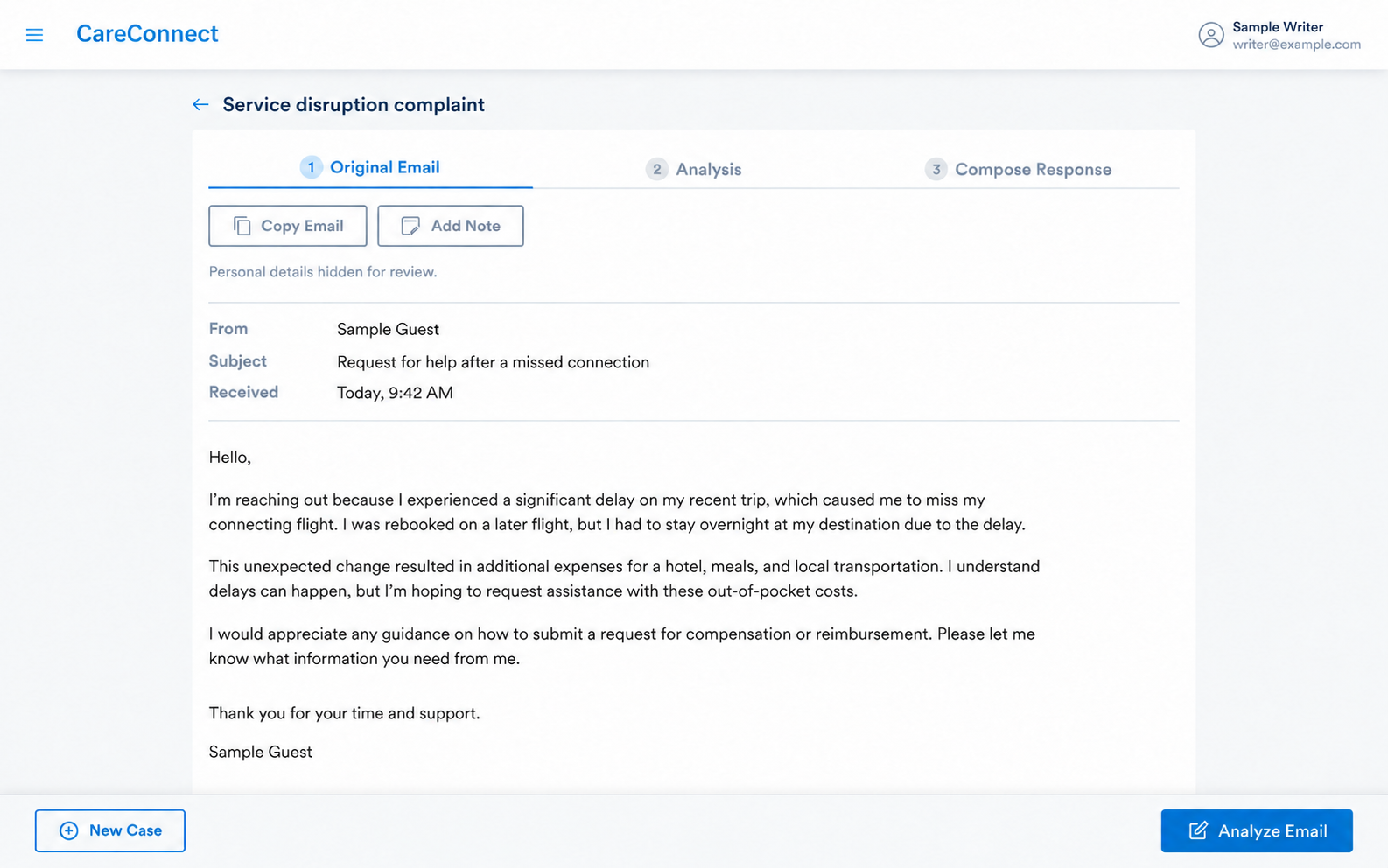
Source context
Read the customer's words before relying on an interpretation.
Follow-up context
A reply may depend on earlier correspondence that generated output does not fully carry forward.
The source correspondence is the starting point for understanding the customer's situation. Public-safe recreation with representative data; annotations describe the design direction, not measured interface outcomes.
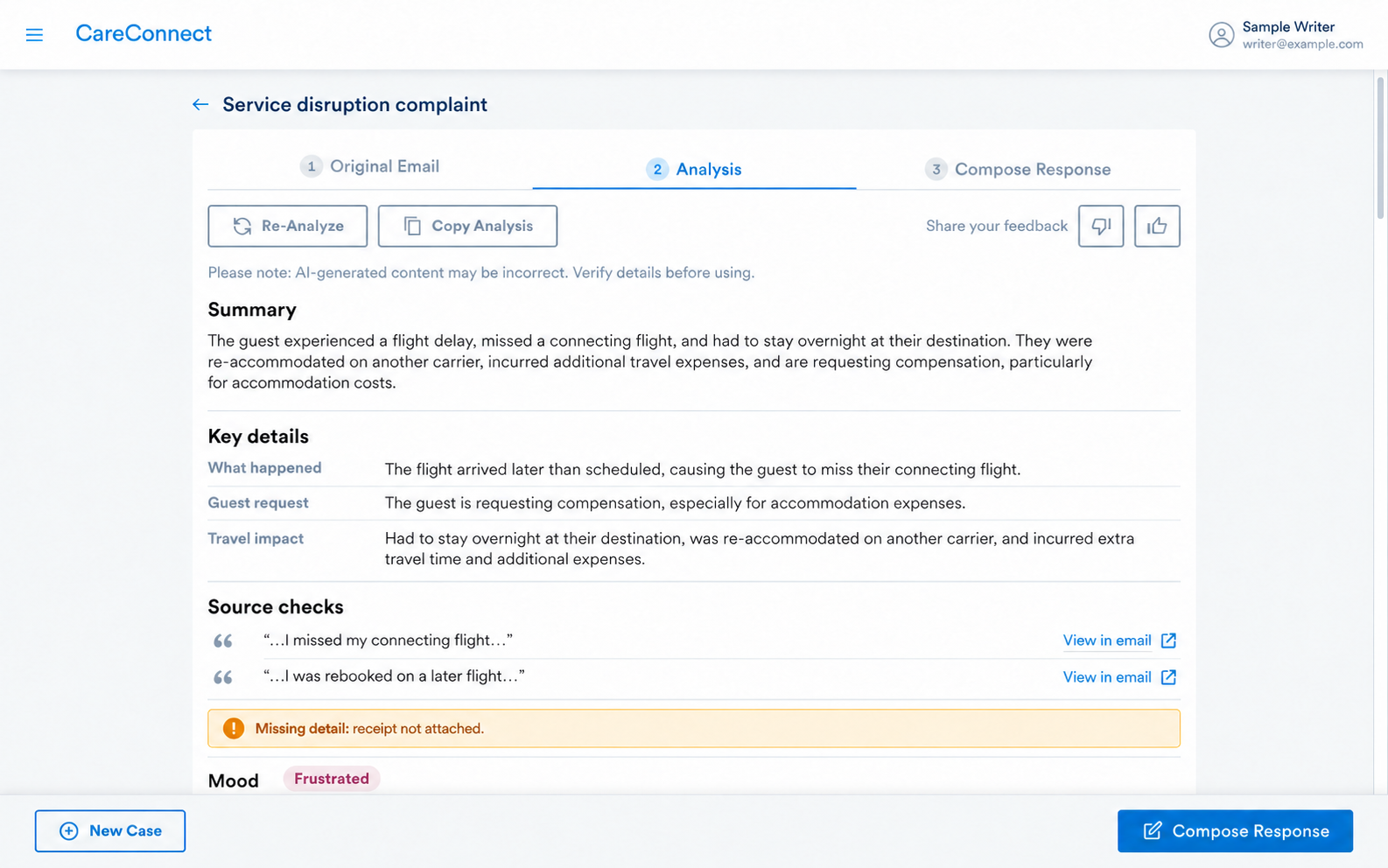
Generated interpretation
A structured summary helps agents get started; completeness still needs evaluation.
Compare and verify
Check key details against the source and look for missing context before composing.
Analysis offers orientation, not a substitute for the source. Public-safe recreation with representative data; annotations describe the design direction, not measured interface outcomes.
The experience needed to support judgment about AI output—not just make the output easy to consume.
03 · Review
Human review wasn't a final checkbox. It was a design requirement.
What the work revealed
DOT and organizational requirements kept review and accountability central. The person sending the response needed to understand and own what it communicated.
My response & design direction
I centered assisted analysis, editable composition, verification, and agent review in the interaction model. Generated content was a starting point the agent could question and change—not an unquestionable answer.
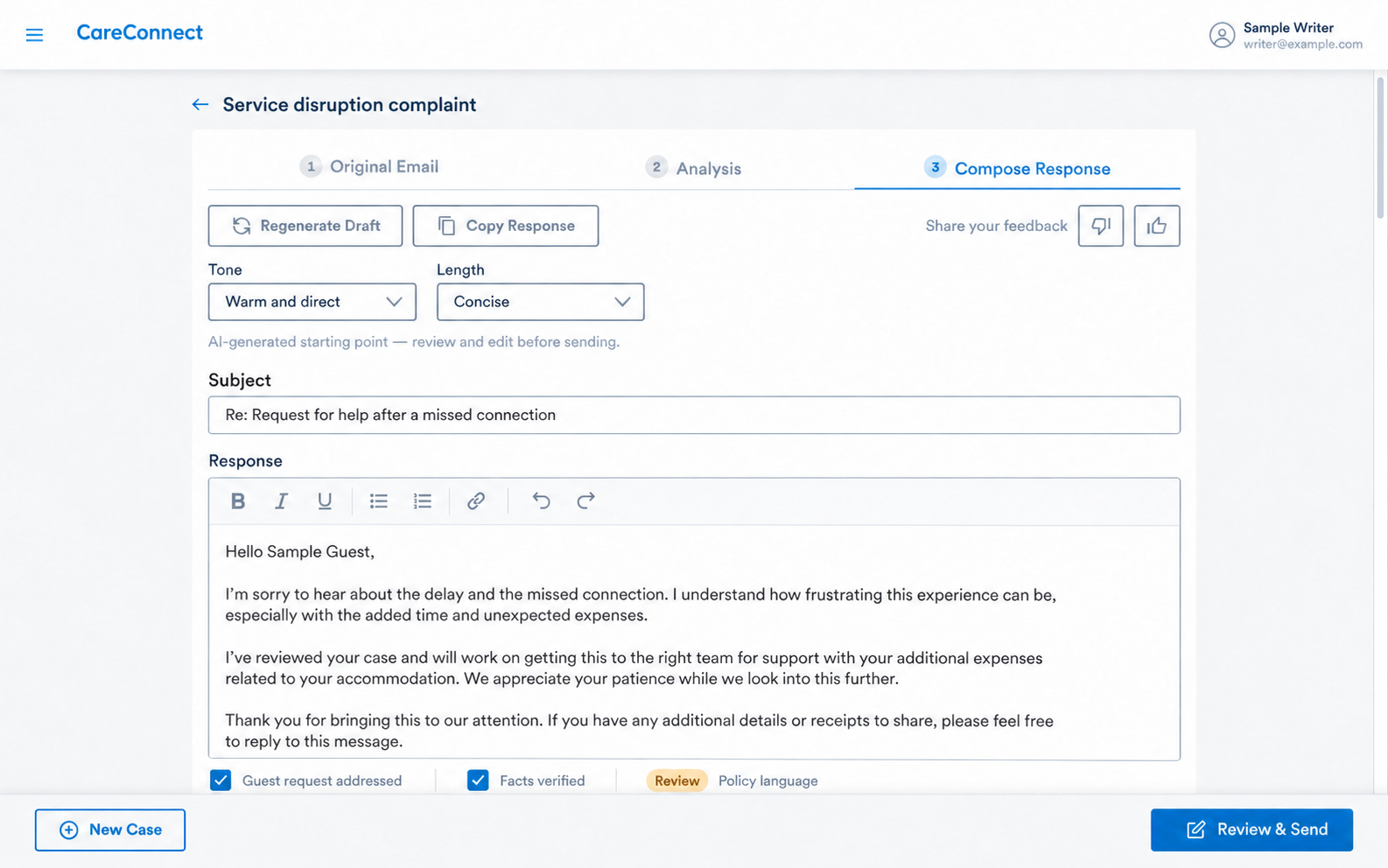
Editable starting point
The agent can adjust the draft to fit the customer's situation.
Verification & review
The agent checks details, assesses appropriateness, and remains accountable for the final response.
The composition direction preserves editing and review before communication. Public-safe recreation with representative data; annotations describe the design direction, not measured interface outcomes.
Technical capability doesn't determine the right division of responsibility.
Research → decisions
What agents taught us—and how it changed the work.
Finding → design or product response. These are qualitative directions, not quantified outcomes or proof that each issue was resolved.
- Summaries and drafts gave agents a useful starting point.
- Support analysis and composition alongside evaluation and review.
- Follow-up correspondence could lose context.
- Prioritize reply handling and share the limitation with the AI team.
- Moving content to and from Astute created friction.
- Use handoff feedback to inform interface iteration.
- Trust, habits, and preferences varied.
- Separate adoption, usability, trust, and workflow fit rather than treating non-use as an interface failure.
- Regulatory and organizational accountability stayed with the agent.
- Keep editing, verification, and review in the interaction model.
Pilot → rollout
Testing with agents revealed more than usability issues.
I partnered with Customer Care leadership to select approximately eight pilot agents. Ongoing feedback, synthesis, and iteration helped us understand both the interface and the conditions around its use.
Successful task completion and voluntary adoption were different questions. An agent could use the tool and still prefer an established process, have different levels of trust, or find that it didn't fit a particular situation.
- 01
Initial interface
The first version of assisted analysis and drafting.
- 02
~8-agent pilot
Selection with Customer Care leadership; ongoing agent feedback.
- 03
Research synthesis
Distinguish interface needs from context, trust and preference.
- 04
Iteration
Translate feedback into interface and product priorities.
- 05
Broader rollout
CSA email letter-writing team; later groups including Central Baggage and Advocacy.
- 06
Post-rollout evaluation
Observe task time and check behavioral analytics.
- 07
Ongoing evolution
Continue the interface as additional groups began using it.
Measured outcome
25% less time on the observed task. Human review preserved.
- Without CareConnect
- 13:29
- With CareConnect
- 10:05
What was measured—and what wasn't
I designed and conducted the observed task comparison and checked it with behavioral analytics. Participants partially overlapped with the pilot.
Timing began with the case already open in Astute. In the CareConnect condition, it ended when information was pasted back into Astute. The exact comparison sample size and exact baseline stopping action are not documented.
This is reduced time within the measured task segment—not complete case-resolution time. It does not establish department-wide causality, universal adoption, or a guaranteed gain for every agent.
Human review and accountability remained part of the workflow. The result matters alongside that boundary, not instead of it.
Collaboration
The work extended beyond the interface.
I partnered on participant selection, translated evidence into interface and product priorities, and shared AI context limits with technical partners. I also contributed to the CareBot → CareConnect rename, created onboarding guidance, and continued the interface as more groups began using it.
- Elise · UX & research
- Research, interface design, evidence synthesis, onboarding guidance, and task-time evaluation.
- Customer Care & product
- Operational partnership, participant selection, agent feedback, and shared product priorities.
- Engineering & Photon AI
- Engineering implementation and AI service ownership; technical partners for context limitations.
Reflection
Designing responsible AI is about more than what the technology can do.
Technical capability is not the same as appropriate responsibility. Speed, adoption, and usability are incomplete measures on their own. The better question is whether the whole system helps people carry their responsibilities more effectively.
Responsible AI means deciding what technology can do—and what people must remain empowered to understand, verify, and control.
CareConnect wasn't about replacing the person writing the response. It was about giving that person better support for the work that still required them.
Want to go deeper into the research and decisions?
Detailed research artifacts, design iterations, and process documentation are available for private discussion, subject to confidentiality requirements.
Discuss this project